

An electric scooter is a convenient way to travel short distances without relying on a car or public transport. You charge its battery, switch it on, and use an electric motor to move. But if you are thinking about buying one, there is more to understand than just how it works.
Battery capacity, motor power, riding range, braking systems, and local laws can all affect your experience.
In this guide, we’ll look at the basics of electric scooters, explain their main features in simple language, and help you understand what matters before choosing your first one.
Table of Contents
What Is an Electric Scooter?
An electric scooter is a two-wheeled personal transportation device powered by an electric motor and a rechargeable battery. Most models have a standing deck, handlebars, brakes, and a throttle that controls acceleration.
Unlike a traditional kick scooter, an electric scooter can move using motor power without requiring you to push off the ground continuously.
Most adult electric scooters are designed for short trips, commuting, local errands, and recreational rides. Some are lightweight enough to carry onto public transport, while others are built for longer distances or more demanding terrain.
In simple terms, an electric scooter is a rechargeable, motor-powered scooter designed to help you travel from one place to another.
How Does an Electric Scooter Work?
The basic process is straightforward. The battery stores electrical energy, the controller manages how that energy is delivered, and the motor turns it into movement.
Here is how the main process works:
- Charge the battery. Electricity is stored in the battery for later use.
- Turn on the scooter. The electrical system becomes ready for operation.
- Use the throttle. On most models, pressing or twisting the throttle sends a signal to the controller.
- The controller manages power. It regulates the electricity supplied to the motor.
- The motor turns the wheel. The wheel rotates and moves the scooter forward.
When you slow down, the brakes reduce the scooter’s speed. Some models also offer regenerative braking, which can recover a small amount of energy during braking.
The exact system varies by model. Some scooters use a motor in the front wheel, while others use a rear-wheel or dual-motor setup.
What Are the Main Parts of an Electric Scooter?
You do not need to be a mechanic to understand an electric scooter. However, knowing its main components can help you compare models and recognise potential problems.
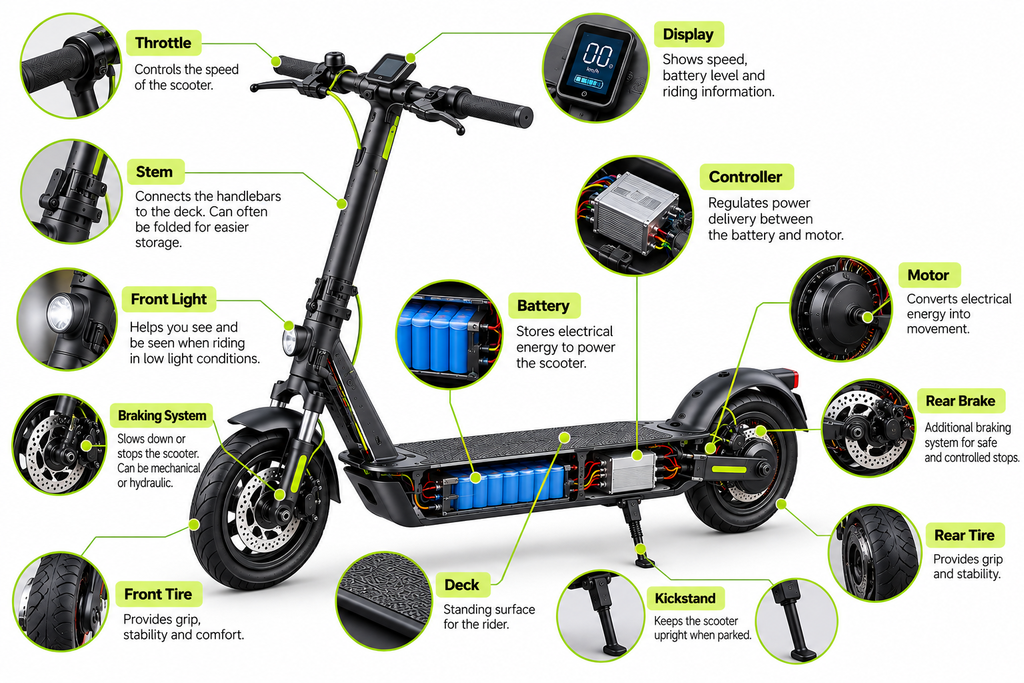
| Component | What it does |
|---|---|
| Battery | Stores the electricity used to power the scooter. |
| Electric motor | Converts electrical energy into movement. |
| Controller | Regulates power delivery between the battery and motor. |
| Braking system | Slows or stops the scooter when needed. |
| Tires | Provide grip and affect comfort and handling. |
| Frame and deck | Support the rider and the scooter’s components. |
| Handlebars and throttle | Help you steer and control acceleration. |
| Display and lights | Show riding information and improve visibility. |
These parts work together, so the quality of the whole scooter matters. A powerful motor alone does not make a scooter safe, comfortable, or reliable.
What Are the Different Types of Electric Scooters?
Electric scooters are designed for different riders and situations. Understanding the main categories will help you narrow down your options.
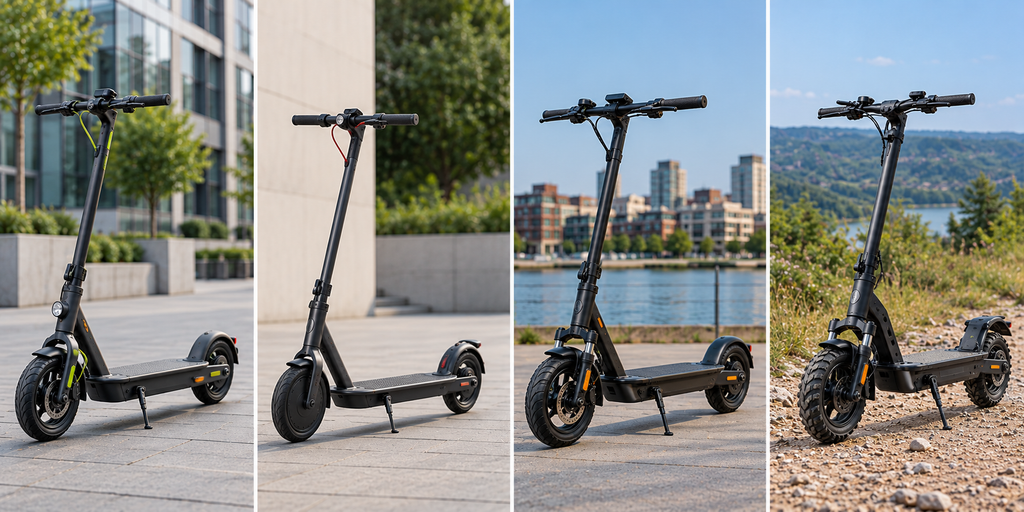
Commuter scooters
Designed for everyday trips to work, school, shops, or public transport connections. They often balance portability, comfort, and range.
Lightweight and portable scooters
Usually easier to carry and store. They can be useful for apartment living or combining scooter rides with public transport, although lighter models may have smaller batteries.
Long-range scooters
Built with larger battery capacities to cover greater distances between charges. They can be heavier and more expensive than basic commuter models.
Performance scooters
Focus on acceleration, speed, and power. Their capabilities may come with greater weight, higher prices, and additional safety considerations.
Off-road scooters
Often feature more robust tires, suspension, and frames for rougher surfaces. Their suitability for public roads depends on local regulations and the specific model.
Children’s electric scooters
Designed for younger riders, generally with age-appropriate dimensions and performance. Check the manufacturer’s age guidance and local rules before choosing one.
There is no single best type for everyone. A scooter that works well for a short daily commute might be inconvenient for someone who needs to carry it upstairs or travel much longer distances.
Which Electric Scooter Specifications Matter?
Product pages can contain many technical terms, but a few specifications are especially useful for beginners.
Battery capacity
Usually measured in watt-hours (Wh), battery capacity gives you an idea of how much energy the battery can store. A larger capacity can support a longer ride, although actual range also depends on the motor, rider weight, terrain, temperature, speed, and riding style.
Motor power
Motor power is commonly listed in watts (W). It can help you compare models, particularly when considering acceleration and hill climbing. However, wattage alone does not tell you exactly how a scooter will perform.
Maximum range
This is the distance a scooter is advertised to travel on a charge under specified conditions. Real-world range can be considerably lower, so avoid assuming you will always achieve the advertised figure.
Maximum speed
The advertised top speed is not necessarily legal on public roads where you live. Local speed limits and vehicle classifications matter more than the number shown on a product page.
Weight and load capacity
The scooter’s own weight matters if you need to carry it. Its maximum permitted load tells you how much weight it is designed to support, including the rider and anything being carried.
Water-resistance rating
An IP rating describes protection against certain types of dust or water exposure. It does not automatically mean a scooter is waterproof or safe to ride through deep puddles.
For example, if two scooters advertise ranges of 30 km and 50 km, the second may suit longer journeys. However, you should also compare weight, charging time, comfort, braking, and the conditions under which those ranges were measured.
The best specification is the one that fits your actual journey, not necessarily the biggest number on the box.
What Are the Benefits and Limitations of Electric Scooters?
Electric scooters can be useful for short journeys, especially when driving feels unnecessary or walking would take too long. However, they also have limitations worth considering before buying one.
Benefits
- Convenient for short trips: Useful for commuting, shopping, and local errands where riding is permitted.
- Rechargeable: You can charge the battery using a compatible charger and suitable power outlet.
- Compact transportation: Many models take up less space than bicycles or cars.
- Potentially lower running costs: Electricity and routine maintenance may cost less than running a car, depending on how much you travel and what transport you replace.
- Useful for mixed journeys: Portable models may help with the first or last part of a trip using public transport.
Limitations
- Limited range: You may need to recharge during the day if your journey is longer than the battery can comfortably support.
- Weather exposure: Rain, wind, cold temperatures, and slippery surfaces can make riding less comfortable or more hazardous.
- Uneven surfaces: Small wheels can be less forgiving on potholes, loose gravel, and rough roads.
- Theft risk: Secure storage and a suitable lock are important, particularly when leaving the scooter in public.
- Charging and battery care: You need a safe place to charge and store the scooter.
- Local restrictions: Some areas limit where scooters can be used, their maximum speed, or which models are allowed.
Think about your normal route before buying. A scooter that performs well on smooth cycle paths might be a poor choice for a route with steep hills, rough surfaces, or no permitted riding space.
How Much Does an Electric Scooter Cost?
Electric scooter prices vary considerably by brand, battery size, performance, build quality, and intended use. As a broad guide, these are illustrative price ranges in US dollars, not current quotes for specific products.
| Category | Illustrative price range |
|---|---|
| Basic entry-level scooters | $200–$400 |
| Mid-range commuter scooters | $400–$900 |
| Premium commuter and long-range models | $900–$1,500+ |
| High-performance scooters | $1,500–$3,000+ |
Actual prices can fall outside these ranges, and availability varies by country.
Remember to consider more than the purchase price. A suitable helmet, lock, replacement tires, brake servicing, and other maintenance costs can add to your overall spending.
A sensible approach is to set your budget first, then look for the safest and most practical scooter within it rather than paying extra for specifications you may never use.
Electric Scooter Battery and Charging Basics
The battery is one of the most important components of an electric scooter. Its lifespan depends on factors such as battery quality, charging habits, storage conditions, temperature, and how frequently the scooter is used.
To help care for the battery:
- Use the charger recommended by the manufacturer.
- Follow the manual’s charging and storage instructions.
- Keep the scooter and charging area away from excessive heat and moisture.
- Inspect the battery and charger for damage.
- Stop using a battery that appears swollen, damaged, unusually hot, or otherwise abnormal.
- Do not charge a damaged battery or leave charging equipment in an unsafe location.
Lithium-ion batteries can cause fires if damaged, defective, or improperly handled. In the United States, the Consumer Product Safety Commission advises consumers to follow product safety guidance and use compatible charging equipment.
Never assume that charging overnight or leaving a scooter plugged in for long periods is appropriate for every model. Follow the instructions for your specific scooter.
For additional battery and charging precautions, the U.S. Consumer Product Safety Commission’s micromobility safety guidance explains how to reduce risks when using and charging electric scooters and similar devices.
Are Electric Scooters Safe?
An electric scooter can be used safely, but riding involves risks. Small wheels, uneven surfaces, sudden braking, traffic, and poor visibility can all contribute to accidents.
Before riding, keep these precautions in mind:
- Wear a properly fitted helmet.
- Learn how the brakes and throttle respond before riding in traffic.
- Start slowly and practise turning and stopping in a quiet area.
- Use lights and reflective clothing when visibility is poor.
- Keep both hands available for steering and avoid distractions.
- Slow down on wet, loose, or uneven surfaces.
- Check the tires, brakes, lights, and folding mechanism before riding.
Protective equipment and careful riding reduce risk, but they cannot eliminate it. Choose routes that are appropriate for your experience and follow the rules where you ride.
What about electrical safety certification?
If you are shopping in the United States, you may encounter references to UL 2272, a standard associated with the electrical systems of personal e-mobility devices, including applicable electric scooters.
You can read more about UL 2272 electrical safety evaluation and certification for personal e-mobility devices from UL Solutions.
Certification and regulatory requirements differ by product and market. Check the actual model and relevant documentation rather than relying only on a seller’s general safety claims.
Are Electric Scooters Legal?
Electric scooter laws vary by country and sometimes by city or region. Rules may cover:
- Minimum rider age
- Maximum permitted speed
- Where scooters can be ridden
- Helmet requirements
- Lights and other equipment
- Insurance, registration, or vehicle approval
- Whether riding on pavements, roads, or cycle paths is allowed
Do not assume that a scooter is legal on public roads just because it is sold online. A model’s top speed, motor power, and classification may affect whether it can be used legally.
Before buying, check the current rules from the official transport or road-safety authority for your location. If you plan to ride in another country, check its rules separately.
How to Choose Your First Electric Scooter
Before comparing brands and models, think about how you will actually use the scooter.
1. Work out your daily distance
Estimate your usual round trip and allow a reasonable margin beyond the advertised range. This gives you more flexibility when conditions reduce battery performance.
2. Think about portability
If you need to carry the scooter upstairs, store it under a desk, or take it on public transport, weight and folded dimensions may matter more than maximum speed.
3. Check your route
Consider hills, road surfaces, weather, traffic, and whether there are suitable legal routes for riding.
4. Prioritise safety and build quality
Look closely at the braking system, tire type, lights, frame construction, and available manufacturer support.
5. Check the practical details
Review the warranty, replacement-part availability, charging requirements, weight limit, and local legal restrictions.
6. Compare the total cost
Include any necessary safety equipment, locks, maintenance, and replacement parts in your budget.
You do not need the most powerful scooter or the longest advertised range to make a good choice. For many beginners, a reliable commuter model that fits their route and is easy to handle will be more useful than a heavier, faster alternative.
Is an Electric Scooter Right for You?
An electric scooter may suit you if you regularly travel short distances, have somewhere safe to store and charge it, and can ride on suitable routes.
It may be less practical if your journeys are long, your route has rough surfaces or steep hills, or local regulations significantly restrict scooter use.
Before deciding, ask yourself:
- Can the scooter comfortably cover my normal journey?
- Do I have a safe place to charge and store it?
- Can I ride legally on my intended route?
- Am I comfortable balancing, braking, and riding around other road users?
- Would a bicycle, public transport, or walking be a better option?
Answering these questions honestly will help you decide whether an electric scooter fits your daily life.
Electric Scooter vs Other Transportation Options
Electric scooters are one of several ways to travel short distances. Each option has its own strengths.
| Transport | Main advantage | Main limitation |
|---|---|---|
| Electric scooter | Compact and convenient for short trips | Range, weather, and local restrictions |
| Kick scooter | Simple and does not require charging | Requires physical effort |
| Electric bicycle | Useful for longer journeys and varied routes | Usually larger and needs more storage |
| Car | Suitable for longer journeys and carrying passengers or goods | Higher ownership and running costs |
There is no universal winner. Your budget, route, storage space, travel distance, and local conditions should guide the decision.
What Should You Do Before Your First Ride?
Before setting off, take a few minutes to check your scooter and prepare yourself.
- Read the manufacturer’s instructions.
- Check the battery level and tire condition.
- Test the brakes at low speed in a safe area.
- Check that the handlebars and folding mechanism are secure.
- Make sure the lights work.
- Wear a properly fitted helmet and suitable footwear.
- Practise accelerating, turning, and stopping away from traffic.
- Confirm the rules for your intended route.
Your first ride should be about getting comfortable with the scooter, not testing its top speed. Increase your confidence gradually as you learn how it handles.
These checks are a good starting point, but your scooter also needs regular care. Read our electric scooter maintenance guide to learn how to look after its tires, brakes, battery, and other components.
Frequently Asked Questions
Do electric scooters need petrol?
No. Electric scooters use a rechargeable battery to power an electric motor, so they do not need petrol.
How far can an electric scooter travel on one charge?
It depends on the battery, scooter design, rider weight, speed, terrain, temperature, and other conditions. Use the advertised range as a guide rather than a guarantee.
How long does an electric scooter battery last?
Battery lifespan varies by battery quality, use, charging habits, storage, and temperature. Follow the manufacturer’s care instructions and watch for changes in performance or signs of damage.
Can electric scooters be ridden in the rain?
That depends on the model’s water-resistance rating and the manufacturer’s instructions. Even a water-resistant scooter may not be suitable for heavy rain, deep puddles, or flooded areas. Wet surfaces can also reduce traction and increase braking distances.
Are electric scooters suitable for beginners?
Many are designed to be easy to operate, but beginners still need to learn how to balance, turn, brake, and share space safely with other road users. Start slowly and practise in a suitable area.
Do electric scooters need a licence?
Requirements depend on the country or region and sometimes on the scooter’s specifications. Check the official local rules before riding on public roads.
Final Thoughts
An electric scooter can be a practical option for short journeys, commuting, and everyday errands. Understanding how it works, what its specifications mean, and where you can legally ride will help you make a more informed decision.
If you are buying your first scooter, focus on your daily needs, realistic range, safety features, portability, and local regulations. Choose a model that suits your journey rather than paying for performance you may not need.
The right electric scooter is not necessarily the fastest or most expensive one. It is the one that fits your lifestyle and gives you a practical, comfortable way to get around.