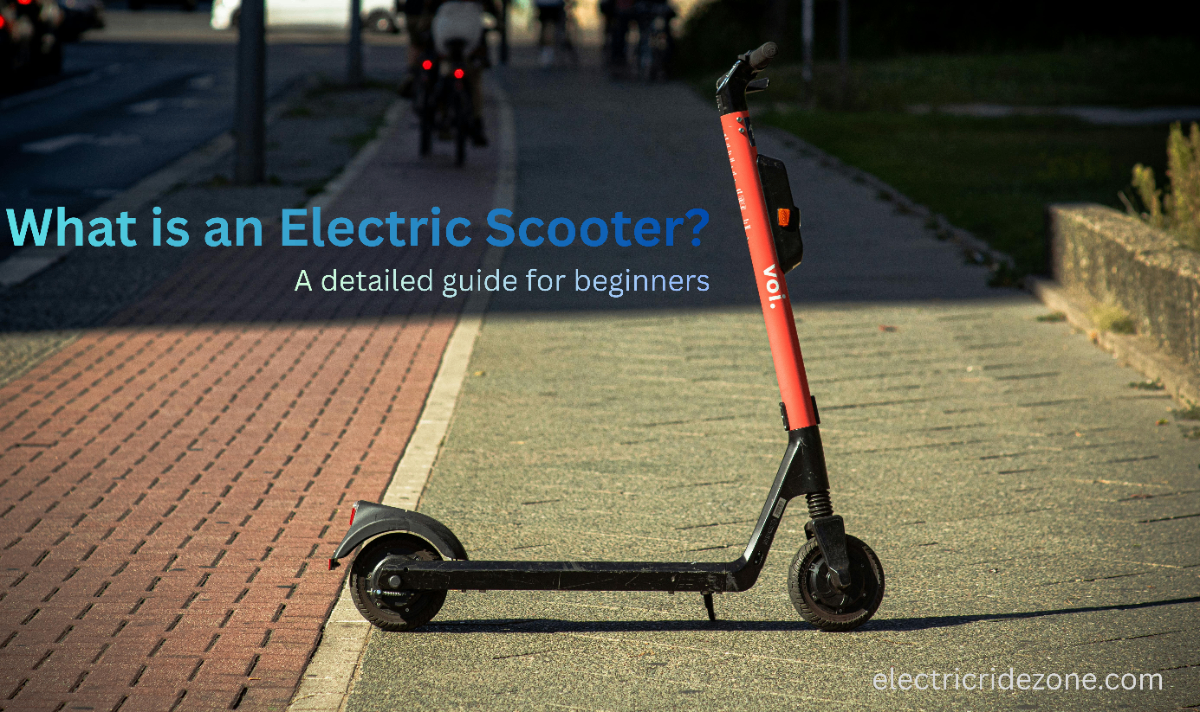
We’ve all been there: sitting in gridlocked traffic, watching the minutes tick by, or dreading that sweaty, mile-long walk from the train station to the office. If you’ve been looking for a greener, faster, and frankly more fun way to get around, you’ve probably noticed the explosion of personal electric vehicles on your local streets. Right at the center of this movement is the electric scooter.
But let’s be honest—if you are totally new to the world of micromobility, all the different specs, models, and terminology can feel pretty overwhelming. What exactly makes a good electric scooter? How do they even work, and most importantly, is buying one actually the right move for your lifestyle?
You don’t have to figure it out alone. This complete beginner’s guide covers everything you really need to know. We’ll break down the components, walk through the real-world costs, and cover the safety basics so you can make a confident, informed decision without the guesswork.
Table of Contents
What Is an Electric Scooter?
If you want the simplest definition, picture the classic two-wheeled kick scooter you might have ridden as a kid, but all grown up and packed with modern technology. An electric scooter (or e-scooter) is a standing personal mobility vehicle powered by an electric motor and a rechargeable lithium-ion battery. Unlike traditional kick scooters, e-scooters use a motorized hub and a handlebar-mounted throttle to provide propulsion, allowing riders to travel at speeds typically ranging from 15 to 25 mph without physical exertion.
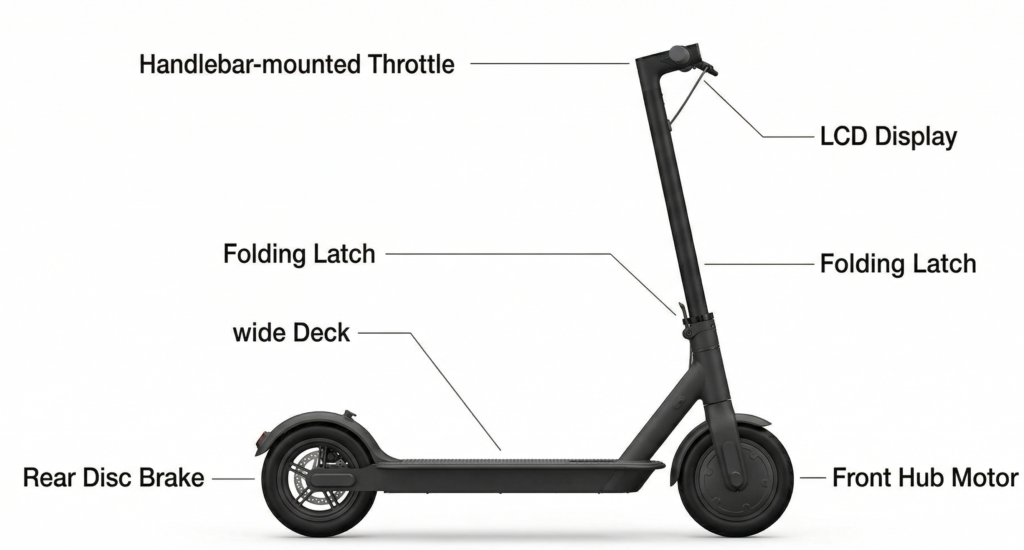
Instead of kicking the pavement until your leg burns, the scooter does all the heavy lifting for you. You just step onto the platform (called the deck), grab the handlebars, and gently press the throttle to control your speed. Because they are fully battery-powered and produce zero tailpipe emissions, they’ve become a major part of the shift toward sustainable personal electric mobility. They are built perfectly for urban environments and those short-distance trips where taking a car is just too much of a hassle.
Types of Electric Scooters
When you first start shopping, you’ll quickly realize that not all scooters are built for the same rider. Manufacturers design them with very specific environments in mind. Here is a quick look at the main types you’ll come across:
| Type | Best For | Speed Range | Price Range |
| Commuter | Daily travel, paved city roads | 15–25 mph | $400–$800 |
| Off-Road | Rough terrain, dirt trails | 20–40+ mph | $800+ |
| Kids | Beginners, riding in the driveway | 10–15 mph | $150–$300 |
| Ultra-Portable | Last-mile transit, carried on trains | 12–15 mph | $300–$600 |
Commuter Scooters
If you just want to get to work and back, this is your go-to. Commuter scooters are the golden middle ground. They offer a great balance of battery range, decent speeds, and a folding mechanism so you can easily carry them into an elevator or store them under your desk.
Off-Road Scooters
Think of these as the dirt bikes of the scooter world. They feature heavy-duty suspension, rugged pneumatic tires, and usually two motors instead of one. They can easily power up steep hills and handle dirt trails, but the trade-off is that they are very heavy and tough to carry.
Kids Scooters
These are lightweight, incredibly simple scooters made specifically for younger riders. They cap out at much safer, lower speeds and help kids learn the absolute basics of personal electric mobility without the intimidating power of an adult model.
How Electric Scooters Work (High-Level Overview)
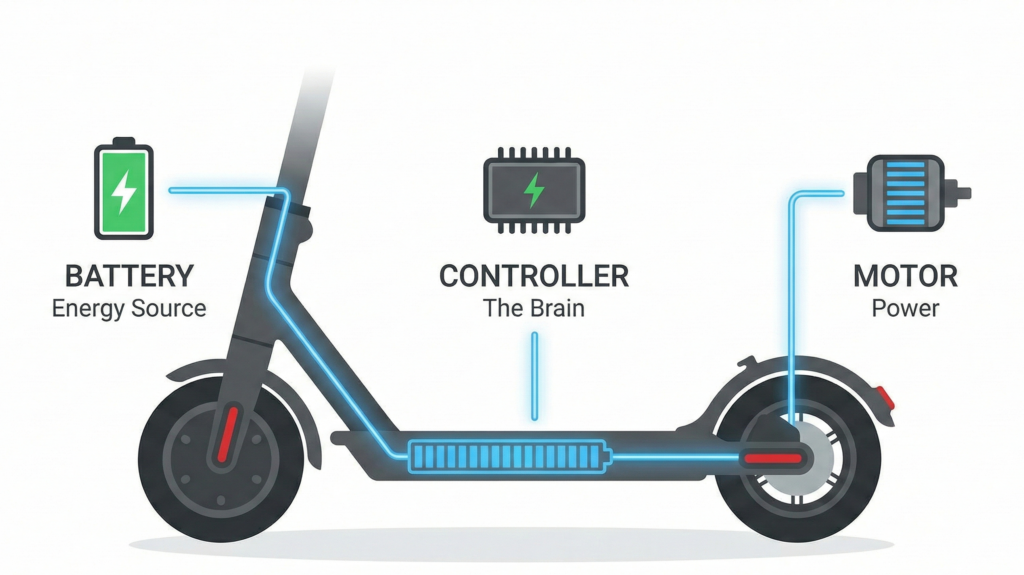
You definitely don’t need an engineering degree to understand what’s happening under your feet. The way an electric scooter moves boils down to a very simple flow of energy:
- Battery: This is the fuel tank that stores all your electrical energy.
- Throttle: When you push the throttle with your thumb, you are basically asking the scooter for power.
- Controller: Think of the controller as the scooter’s brain. It takes your throttle request and decides exactly how much power to pull from the battery and send to the wheels.
- Motor: The motor (usually hidden right inside the wheel) spins, moving you smoothly down the street.
When you need to stop, scooters use a mix of traditional mechanical brakes (just like a bicycle) and electronic braking, which smartly cuts the motor’s power and even feeds a tiny bit of energy back into your battery.
Main Components of an Electric Scooter
To feel completely comfortable riding, it really helps to know your vehicle’s anatomy. Let’s look at the parts that matter most to your daily ride.
Battery
The heart of your scooter is its lithium-ion battery, usually tucked away safely under the deck you stand on. Battery capacity is measured in Watt-hours (Wh). Simply put, a bigger battery means you can ride farther before needing to plug in. It’s also the heaviest and most expensive part of the whole machine.
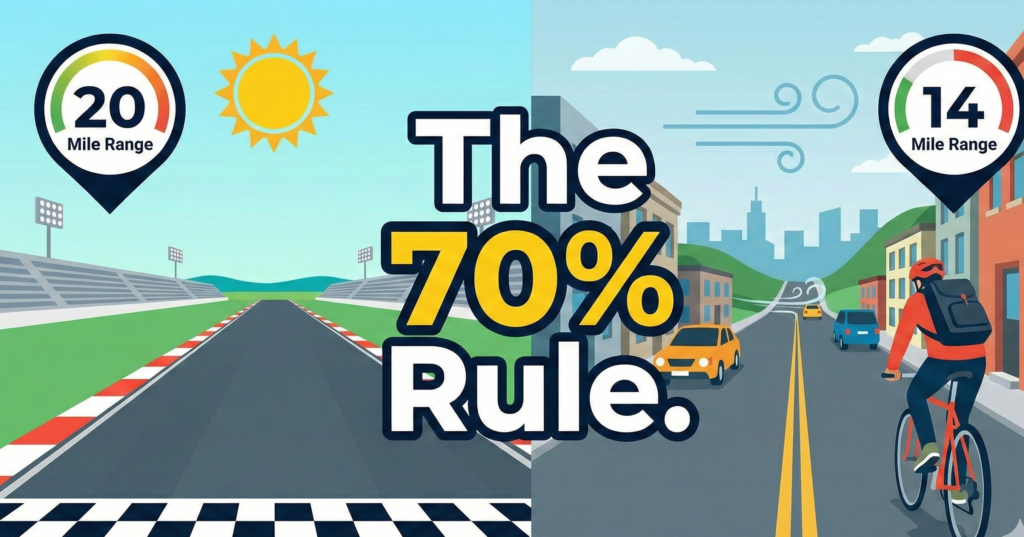
Pro Tip: Be wary of ‘advertised range.’ Manufacturers typically test on flat tracks with a 165 lb rider at a slow 9 mph. In the real world—with stop-and-go traffic and 15 mph speeds—you should expect 60%–70% of the range listed on the box. Also, remember that lithium-ion batteries lose about 15%–20% efficiency once temperatures dip below 50°F (10°C).
Electric Motor
Most electric scooters use a “hub motor,” meaning the motor is built entirely into the center of the wheel. Standard commuters usually have one motor, while high-performance ones have two. Motor power is measured in Watts (W)—the higher the wattage, the easier it is to accelerate quickly and conquer steep hills.
Controller & Electronics
As we mentioned, the controller manages the electricity flow. It’s also the part responsible for your speed limits, making sure your motor doesn’t accidentally draw more power than the battery can safely handle and fry the system.
Braking System
You’ll rely on two types of brakes: electronic (using the motor to slow you down) and mechanical (physical brakes like discs or drums). High-quality scooters will almost always use a combination of both to make sure you can stop on a dime if a car pulls out in front of you.
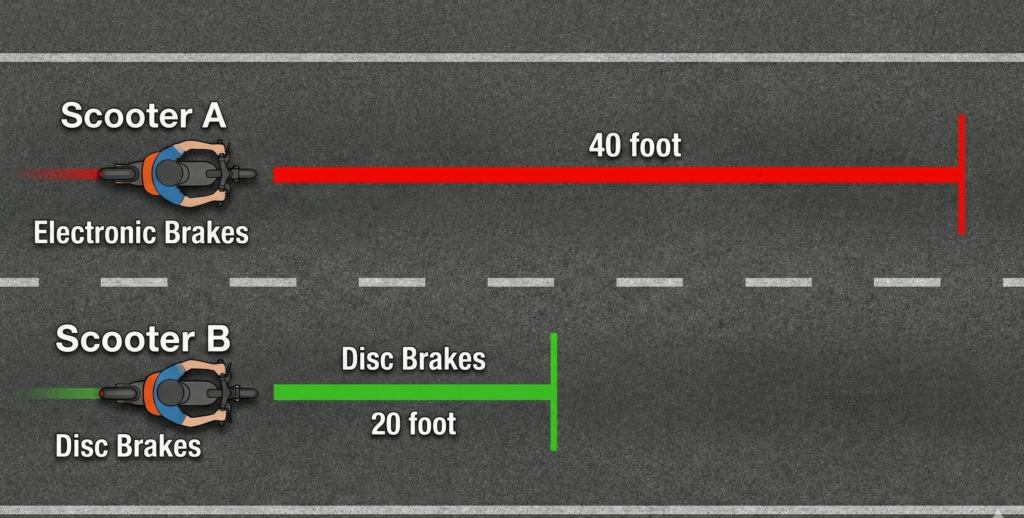
Safety Note: The type of brake matters for your safety. At 15 mph, you are moving at 22 feet per second. A scooter with dual disc brakes can usually stop in 15–20 feet, whereas a scooter with only electronic braking can take up to 40 feet to come to a complete halt—nearly double the danger zone.
Frame, Deck & Tires
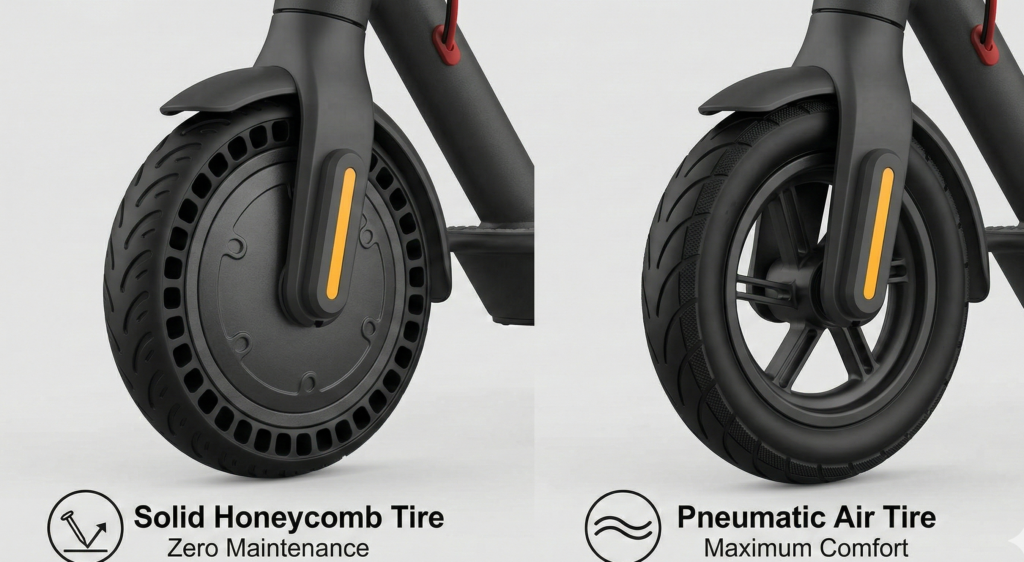
Most frames are built from aerospace-grade aluminum, so they are tough but not impossibly heavy. Tires are a big deal for your comfort: solid tires will never go flat but offer a bumpy ride, while air-filled (pneumatic) tires give you a buttery-smooth ride but require you to occasionally check the air pressure.
What Are Electric Scooters Used For?
Electric scooters are incredibly versatile, and people are finding all sorts of clever ways to fit them into their routines. Mostly, you’ll see them used for:
- Commuting: Swapping out a stressful 15-minute drive in traffic for a breezy ride in the bike lane.
- First-Mile / Last-Mile: The perfect tool for getting from your front door to the bus stop without having to walk.
- Campus Life: Helping college students cross massive university grounds between classes without breaking a sweat.
- Casual Mobility: Grabbing coffee down the street, visiting a friend nearby, or just enjoying some fresh air on a Sunday afternoon.
Every time someone uses a scooter for these quick trips, it takes one more car off the road, helping to clear up local traffic for everyone.
Electric Scooter vs Kick Scooter
They might look like cousins, but riding an electric scooter is a fundamentally different experience from riding a manual kick scooter.
- The Power Source: A kick scooter relies entirely on your physical energy. An electric scooter does the driving for you via its battery and motor.
- Speed & Range: You can travel much faster and significantly farther on an electric model without arriving at your destination exhausted.
- The Reality of the Ride: Let’s be honest, kick scooters are mostly recreational. Electric scooters are legitimate commuting vehicles capable of safely navigating city streets alongside traffic.
Benefits of Electric Scooters
So, why is everyone suddenly riding them? The perks are actually pretty hard to ignore once you experience them.
Real Convenience
Imagine bypassing bumper-to-bumper traffic, taking scenic shortcuts through the park, and never, ever having to circle the block looking for a parking spot again.
Incredible Cost Efficiency
When you compare a scooter to the cost of car payments, gas, insurance, and parking garage fees, it practically pays for itself in a few months.
Easy Portability
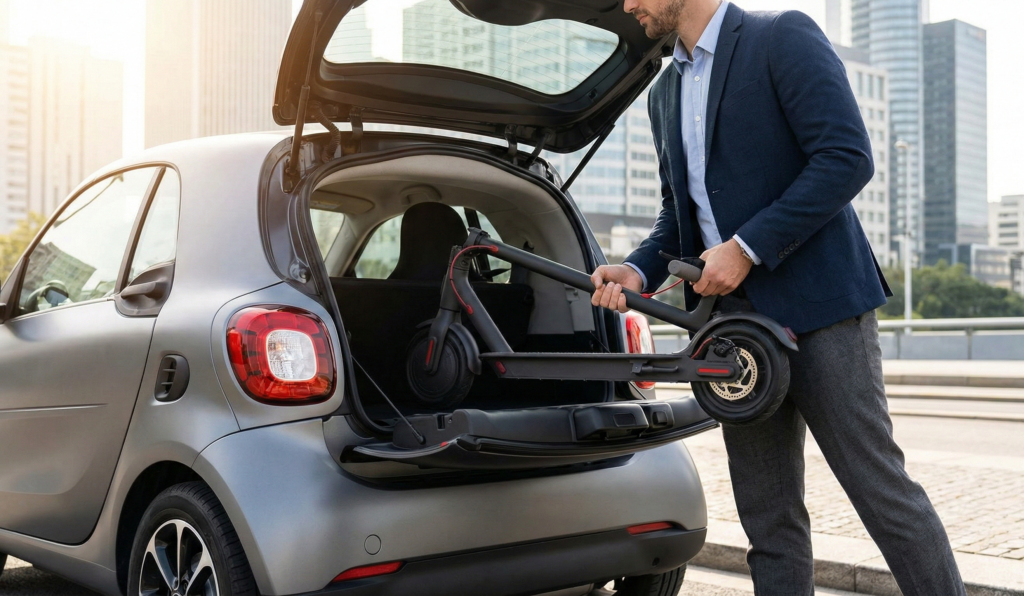
You can’t fold up a bicycle and tuck it under your desk. Most commuter scooters fold down in three seconds, making them incredibly easy to bring inside an apartment or toss into the trunk of an Uber.
A Greener Choice
We all want to do our part for the environment. Because they run entirely on electricity, scooters are a genuinely sustainable form of transport that produces zero local emissions.
Limitations & Drawbacks of Electric Scooters
We want to be totally transparent with you: electric scooters are amazing, but they aren’t flawless. It is important to know their limits before you spend your money.
Range Anxiety
Even the biggest battery eventually dies. If you have a massive 20-mile commute each way, a standard scooter just won’t have the juice to get you there and back without a long charging session at your desk.
Weather Sensitivity
Most scooters are water-resistant, not waterproof. Getting caught in a light drizzle is usually fine, but riding through heavy rain or deep puddles can ruin the electronics. Plus, wet roads are slippery and dangerous.
Feeling the Bumps
Because the tires are small, electric scooters are very sensitive to potholes and gravel. If your neighborhood has terribly maintained roads, your ride might get a little rattled.
Battery Lifespan
Just like your smartphone, the battery inside a scooter will slowly lose its ability to hold a full charge over a few years of daily use.
Cost of Owning an Electric Scooter
Buying the scooter up front is the biggest hurdle. Thankfully, the day-to-day costs are wonderfully low. Let’s look at the estimates in the table below:
| Expense Category | Specific Data Point | Annual Estimate (Daily Commute) |
| Electricity | $0.02–$0.05 per 10 miles (Avg. $0.12/kWh) | ~$15.00 – $25.00 / year |
| Brake Pads | Replace every 500–800 miles | $20.00 – $40.00 / year |
| Tires (Pneumatic) | Replace every 1,500–2,000 miles | $50.00 – $100.00 / year |
| Battery Health | Lose ~20% capacity after 500+ cycles | Replacement after 3–5 years |
Pro Tip: Charging a standard 360Wh battery from 0% to 100% uses about 0.4 units of electricity. Even in high-cost energy areas, you are moving for less than the price of a single gumdrop per mile.
How Fast Can an Electric Scooter Go?
While speed is undeniably exciting, many riders are curious about the top speed of an electric scooter, as it varies by brand. Most riders find that a standard electric scooter can go up to speeds between 15 and 20 mph, which is widely considered the “sweet spot” for urban commuting. But there are some high-performance electric scooters that can reach 40 or even 60 mph, but these “hyper-scooters” require motorcycle-grade safety gear and are often illegal to use on public bike lanes.
For speed lovers, the speed of a standard electric scooter might not sound like a lot, but trust me, when you are standing on a slim metal deck in the open air, 18 mph feels surprisingly fast and is more than enough to get you from one place to another.
While buying or riding an e-scooter, it is important to keep your expectations grounded in both safety and local laws. For a standard city commute, safety should be your top priority, as the faster you ride, the longer your braking distance becomes. Even most cities cap legal speeds at 15 or 20 mph, so pushing your machine to its absolute limit isn’t always practical or legal.
Common Beginner Mistakes While Purchasing
We see new riders make the same mistakes all the time. Let’s save you some money and a lot of frustration:
- Buying the Cheapest Option: Ultra-budget scooters often have flimsy frames, terrible brakes, and batteries that fail after one summer. It’s usually worth spending a little more for reliability.
- Trusting the Box: Manufacturer “max ranges” are tested in perfect, windless conditions with very light riders. In the real world, expect to get about 20% to 30% less range than the box claims.
- Ignoring Weight Limits: Every scooter is built to hold a specific amount of weight. If you ignore this, the scooter will struggle up hills, and the battery will drain incredibly fast.
- Skipping the Helmet: Please, don’t do this. A scooter is a motor vehicle sharing the road with cars. Skipping protective gear is just not worth the risk.
Battery Life, Range & Charging (Overview)
When we talk about “range,” we just mean how many miles you can ride before the scooter dies.
| Battery Size | Expected Range | Best Use |
| Small | 8–12 miles | Quick trips to the corner store |
| Medium | 15–25 miles | A standard daily office commute |
| Large | 30+ miles | Long weekend adventures |
Battery Life: Most quality batteries are rated for 500 to 800 full charge cycles. This means if you charge your scooter every other day, the battery should maintain its health for roughly 3 to 5 years before you notice a significant drop in capacity.
The Reality of Range: Your actual mileage depends on you. Weight is the biggest range-killer. For every 25 lbs you carry over the manufacturer’s test weight, expect your total range to drop by roughly 10%.
Charging It Up: Most standard scooters take about 4 to 8 hours to charge. Most people just plug them in overnight or under their desk at work.
Safety Basics Every Beginner Should Know
Riding a scooter is very intuitive, but you are still zipping around concrete and metal. Safety has to come first.
- Gear Up: A well-fitting helmet is your best friend. If you plan to ride fast, tossing on some gloves and knee pads is a smart move. But not all helmets are created equal. To ensure you’re getting actual protection and not just a plastic shell, we recommend choosing a model with a 4 or 5-star rating from the Virginia Tech Helmet Lab’s independent safety tests.
- Stance Matters: Stand like you’re on a skateboard—one foot in front of the other—and keep your knees slightly bent to absorb the bumps.
- Brake Smartly: Never slam your brakes in a panic. Look ahead, anticipate your stops, and pull the brakes smoothly.
- Stay Alert: Assume that drivers in cars cannot see you. Keep a close eye out for car doors swinging open or pedestrians stepping off the curb without looking.
Maintenance Basics (Beginner Overview)
You don’t need to be a mechanic, but showing your scooter a little TLC will easily double its lifespan.
- Tire Pressure: If you have air-filled tires, check them weekly. Riding on soft tires is the number one cause of flat tires and terrible battery range.
- Test the Brakes: Before you leave the driveway, squeeze the brakes to make sure they feel firm and responsive.
- Battery Habits: Try not to let your battery sit at completely 0% for weeks on end, as this damages the cells. Heat and extreme cold are also the biggest enemies of your scooter’s battery health. For a deep dive into the science of making your cells last for years, Battery University offers excellent research on maximizing lithium-ion battery health.
- Safe Storage: Always try to keep your scooter indoors. Leaving it out in the freezing cold or baking sun will destroy the electronics over time.
Pro Tips: The easiest way to prevent flat tires is to check your pressure weekly. For 10-inch tires, keeping them at 45–55 PSI reduces the risk of ‘pinch flats’ by nearly 50%. Also, use a wrench to check your stem bolts every 250 miles; road vibrations can loosen hardware by 1–2 millimeters, leading to that annoying handlebar wobble.
Are Electric Scooters Legal?
Because this industry exploded so quickly, local laws are still trying to catch up.
The rules change entirely depending on what country, state, or even city you live in. But generally speaking, you’ll run into laws regarding:
- Speed Caps: Cities often limit how fast you can go in public bike lanes.
- Age Requirements: Many places require riders to be at least 16 or 18 years old.
- Helmets: Some cities legally force you to wear a helmet, especially if you are under 18.
⚠️ Always check your local city and state websites to see exactly where you are allowed to ride before you buy. While most states allow e-scooters on bike lanes, rules for sidewalks and speed limits change once you cross city lines. You can check this updated 2026 database of state-by-state scooter laws to see exactly what is required in your area.
Is an Electric Scooter Right for You?
Deciding on a new way to get around usually comes down to three things: Time, Money, and Comfort. To help you see where the e-scooter fits into your life, we’ve compared it against the most common urban transport methods.
📊 Quick Comparison Table (2026 Data)
| Feature | Electric Scooter | Electric Bike | Compact Car | Walking |
| Best Distance | 1–5 miles | 3–15 miles | 10+ miles | < 1 mile |
| Avg. Speed | 15–20 mph | 20–28 mph | 10–25 mph (City) | 3 mph |
| Cost per Mile | $0.01 – $0.02 | $0.02 – $0.04 | $0.16 – $0.25 | $0.00 |
| Portability | High (Folds/Indoor) | Low (Heavy/Rack) | None | N/A |
| Effort Level | Low (Standing) | Moderate (Pedal) | None | High |
| CO2 per km | ~25g | ~22g | ~165g – 270g | 0g |
✔️ You SHOULD Buy an E-Scooter If:
- You want to “Beat the Gridlock”: In dense cities, our testing shows that e-scooters often arrive 5–10 minutes faster than cars for trips under 3 miles because you bypass traffic and park instantly.
- You’re tired of “Hidden” Car Costs: Switching just 15 miles of daily driving to a scooter can save you over $1,500–$2,000 per year in gas and maintenance alone.
- You have zero storage space: Unlike a car (which needs a garage/street spot) or an e-bike (which needs a heavy rack), a scooter folds to fit in a closet or under a desk.
- You want a “Last-Mile” solution: If you park your car in a cheap peripheral lot or take the train, a scooter turns a boring 20-minute walk into a 4-minute “shortcut.”
❌ You Should AVOID (Or stick to a Car/E-Bike) If:
- You have a long highway commute: If your route involves 55+ mph roads, a car is your only safe option. E-scooters are strictly for use on surface streets and in bike lanes.
- You need to haul groceries or kids: A car is a “pack-mule,” and an e-bike can take a child seat. A scooter is strictly for one person and a light backpack.
- You live in an area with constant heavy rain: While cars keep you dry, e-scooters are sensitive to water. Real-world insight: Even with an IPX5 rating, riding a scooter in a downpour is mentally exhausting and physically slippery.
- You struggle with balance: If standing for 20 minutes is difficult for your knees or back, an e-bike with a seat or a car will be significantly more comfortable.
Electric Scooters for Different Riders (Age, Weight, & Needs)
We are all built differently, and personal electric mobility is absolutely not a one-size-fits-all situation. Finding a ride that matches your body and needs is the secret to a great experience.
Electric Scooters for Kids & Teens
It’s important to know that electric scooters aren’t universally meant for children. Adult models simply have way too much power and speed for a child to safely control. If you are shopping for a younger rider, you need a dedicated youth scooter. These are built with lower top speeds and very gentle acceleration to keep them safe. And of course, adult supervision and a good helmet are absolutely critical while they are learning.
Electric Scooters for Heavier Adults
Every scooter comes with a strict weight limit, and it’s not just a polite suggestion. Your body weight heavily impacts how the scooter performs. If you exceed the limit, you’ll likely experience sluggish acceleration, weak brakes, and a battery that drains instantly on hills. Plus, the frame and tires need to be strong enough to support you over bumps. If you are a heavier rider, look for models with dual motors and robust frames—they will make your ride infinitely more enjoyable and safe.
Electric Scooters for Taller or Larger Riders
Your height completely dictates how comfortable you will be. If you are tall and the scooter’s handlebars are too low, you’ll end up hunching over, which hurts your back and makes steering feel very twitchy and unstable. You’ll also want a scooter with a wider deck, so you aren’t fighting to balance your feet, along with larger tires (10 inches or more) to absorb the road vibration that travels up through a larger frame.
Are Electric Scooters Suitable for Everyone?
While they are incredibly accessible, they aren’t perfect for everyone. Because they require you to stand and balance, riders with mobility or balance issues might not feel comfortable. They also aren’t built for incredibly long distances or wildly neglected roads. It’s all about looking at your physical comfort, your daily route, and what makes you feel safest.
The “Pro-Rider” Pre-Ride Checklist (Don’t Skip This!)
Most beginners make the mistake of riding their scooter straight out of the box. From our experience, doing a 5-minute PDI (Pre-Delivery Inspection) can prevent 80% of early accidents and mechanical failures.
- Pump the Tires: Manufacturers often ship tires at 20 PSI to prevent popping in transit. You must pump them to 45–55 PSI immediately. Soft tires are the #1 cause of “pinch flats.”
- The “Stem Shake” Test: Firmly grab the handlebars and rock them back and forth. If you hear a click or feel a wobble, your folding hinge needs tightening.
- Check the 4 Bolts: Most scooters require you to install the handlebars with 4 small bolts. Pro-Tip: Check these after your first 50 miles; the vibration of the road often rattles them loose.
- Brake Bite Check: Pull your brake lever. It should feel firm. If the lever touches the handlebar grip, your brake cable is too loose—tighten it before your first hill!
How This Guide Fits Into Electric Ride Zone
If you are at the very beginning of your journey, consider this article your home base here at Electric Ride Zone.
We built this foundational guide to give you a clear, honest overview of the landscape. Throughout this page, we’ve linked out to deeper, hyper-specific guides to help you master every aspect of your ride. We will keep this hub updated as new tech hits the market, so you always have a trusted place to find your answers.
Final Thoughts
At the end of the day, an electric scooter is so much more than just a fun weekend toy. It is a highly practical, surprisingly affordable, and completely eco-friendly way to reclaim your daily commute.
By taking the time to understand your battery, respecting the vehicle’s real-world limits, and committing to basic safety gear, you can completely change how you navigate your city. Take a breath, do your research, and get ready to enjoy the ride. Welcome to the world of personal electric mobility.
Frequently Asked Questions (FAQ)
What is an e-scooter?
An electric scooter is a standing personal vehicle that uses an onboard electric motor and a rechargeable lithium-ion battery for propulsion. It is specifically designed to bridge the “last-mile” gap in urban commuting, offering a motorized alternative to walking or traditional kick scooters.
How much is an electric scooter?
You can expect to pay between $400 and $800 for a reliable entry-level commuter model. If you need something for rough terrain or higher speeds, high-performance off-road models typically start at $1,200 and can exceed $3,000.
Can you ride an electric scooter in the rain?
You should only ride in wet weather if your scooter has a high IP Rating. An IPX4 rating can handle light splashes, but you need an IPX5 or IPX6 rating to safely ride in actual rain. Most manufacturers advise against it to prevent “water ingress,” which can fry the battery and void your warranty.
How fast can an electric scooter go?
Most standard commuter models are electronically limited to 15.5 mph (25 km/h) for safety and legal compliance. High-performance “hyper-scooters” can reach speeds of 40–60 mph, though these are generally restricted to private property or specialized lanes.
Do you need a license for an electric scooter?
In most regions, you do not need a specific license if the scooter is capped at 15–20 mph. However, some countries and states (such as the UK or specific European regions) may require a provisional license or impose strict age limits, so always check with your local DMV or transport authority first.
Where to buy an electric scooter?
You can find the best selection at specialized online micromobility retailers, major marketplaces like Amazon, or local electric bike and scooter shops. Buying from a dedicated shop often ensures better access to replacement parts and expert warranty support.
Is an e-scooter a motor vehicle?
Legally, yes—most jurisdictions classify them as “motorized transporters.” This means you are subject to many of the same rules as a car, including strict DUI laws and prohibitions against riding on certain pedestrian sidewalks.
How long does it take to charge an electric scooter?
Expect a standard charge to take between 4 and 8 hours. Larger “long-range” batteries can take 12+ hours, though many high-end models now support “dual-charging” (using two chargers at once) to cut that time in half.
What is the fastest electric scooter?
Models like the Rion Thrust or the Dualtron Storm Limited currently lead the pack, with some hitting speeds over 70–80 mph. These are professional-grade machines that require full motorcycle safety gear.
How to lock up an electric scooter?
Because they are highly portable, you should use a heavy-duty U-lock or a specialized cuff lock through the most secure part of the frame (usually the folding mechanism or near the deck). Many riders also hide an Apple AirTag inside the deck as a low-cost backup for tracking.
How to charge an electric scooter?
Simply plug the charger into a standard wall outlet first (ensure the indicator light is green), then connect it to the scooter’s charging port. To protect your battery, avoid leaving it plugged in for days at a time and try to charge on a cool, flat surface.
Why is my e-scooter not turning on?
The most common culprits are a loose connection in the stem, a “tripped” Battery Management System (BMS), or a blown fuse. Try plugging it into the charger; if the light stays green but the scooter won’t boot, it’s likely a wiring or controller issue that needs professional attention.
Is an e-scooter safe?
They are remarkably safe as long as you respect the machine. Statistically, 90% of serious scooter accidents involve riders not wearing a helmet. If you wear your gear and ride defensively, it is a secure and efficient way to travel.
How to charge an e-scooter without a charger?
You should never attempt this. Mismatching voltage or current by even a small amount can cause a lithium-ion fire. If you lose your charger, it is much safer and cheaper to buy a manufacturer-approved replacement than to risk a house fire.
How to change an electric scooter tire?
You will need tire levers and a bit of patience to pry the tire bead over the rim. For pneumatic tires, it’s just like a bicycle: remove the wheel, swap the inner tube, and reinflate to the recommended 45–55 PSI.
How long does an electric scooter battery last?
A well-maintained lithium-ion battery will last 3 to 5 years, or roughly 500–800 full charge cycles. You’ll know it’s time for a replacement when your maximum range drops by more than 30%.
Can I take my e-scooter on a plane?
Almost never. FAA and international airline regulations strictly prohibit lithium batteries over 160Wh on passenger planes. Since even a basic commuter scooter battery is usually 250Wh–360Wh, they are banned from both carry-on and checked luggage.
Can I ride my electric scooter on the sidewalk?
In most major cities, riding on the sidewalk is illegal. Scooters are generally restricted to bike lanes or the far right side of the road to keep pedestrians safe.
How to use an e-scooter?
First, power on the device and give it a small manual “kick” to get moving (most have a “non-zero start” safety feature). Once you have a tiny bit of momentum, gently press the thumb throttle and keep your weight centered over the deck.
How to reset an e-scooter?
For most brands, you can perform a soft reset by holding the Power Button and the Brake Lever simultaneously for 10 seconds. This is a great first step if your screen displays a minor error code or glitches.
How to make an e-scooter go faster?
You can often change “Speed Modes” (Eco, Drive, Sport) directly on the display. While some riders “flash” the firmware to remove factory speed caps, we strongly advise against it as it voids your warranty and puts dangerous stress on the motor and battery.
How to fold an e-scooter?
Most models feature a quick-release lever at the base of the stem. You simply disengage the safety lock, pull the lever, and fold the handlebars down until they click into a hook on the rear fender for easy carrying.